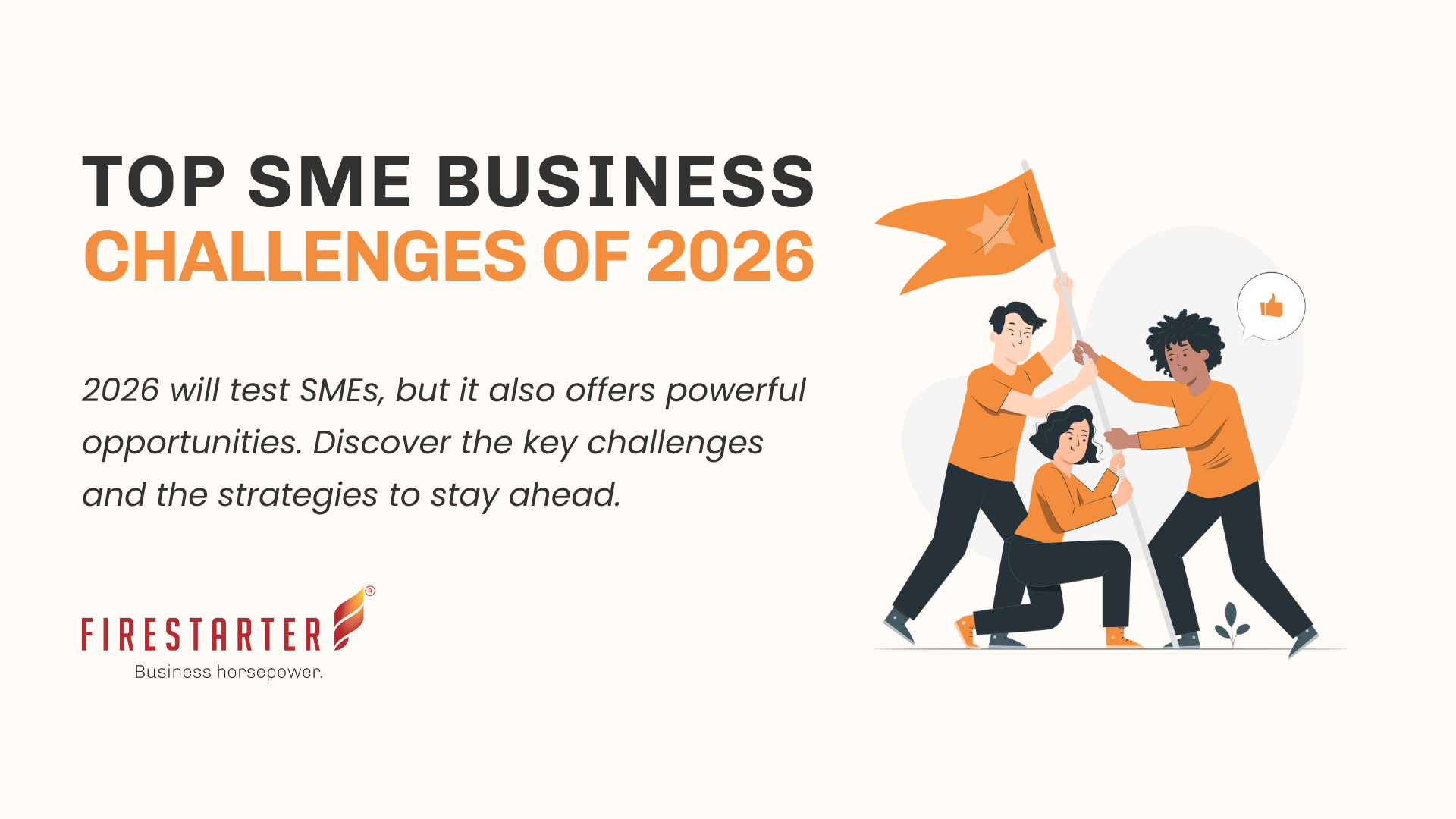
This article explores the most pressing challenges facing UK SMEs in 2026 – from continued uncertainty and rising cyber threats to escalating employment and energy costs, while highlighting the major opportunities emerging in AI adoption, investment incentives, sustainability, and digital transformation. It provides business owners with a practical, solutions‑led guide to navigating economic uncertainty and positioning their companies for growth in the year ahead.
The Top SME Business Challenges of 2026

February 4, 2026
Introduction
SMEs continue to be the backbone of the UK economy. At the tail-end of 2024, there were an estimated 5.49 million SMEs in the UK; by the end of 2025, this had risen to 5.8 million. For those 5.8 million SMEs, 2025 was a year defined by rising operating costs, wage increases, persistent inflationary pressure, cyber threats, and a spike in financial distress.
Many of the challenges we predicted early in our 2025 SME business challenges blog materialised, from increasing National Living Wage rates to heightened cyber risk exposure and pressure from rising energy costs, placing businesses in Britain under strain.
Financial distress accelerated sharply toward year‑end. In Q4 2025 alone, companies in critical distress surged by 43.8% year‑on‑year, reaching 67,369 affected businesses, with all 22 monitored industries showing double‑digit increases. Consumer‑facing sectors, including Leisure & Cultural Activities (+59.1%), Hotels & Accommodation (+53.7%), and Bars & Restaurants (+39%), were among the hardest hit.
Meanwhile, cyber-attacks remained a dominant operational risk. According to UK government data, 43% of UK businesses and 30% of charities experienced an attempted cyber breach in the last 12 months, with medium‑sized (67%) and large businesses (74%) hit the hardest.
Energy costs also moved upward once again: as of April 2025, small business energy costs were around 70% higher than they were in 2021-22, driven largely by wholesale market volatility.
As we embark into 2026, SMEs face a familiar yet evolving landscape of financial, regulatory, digital, and workforce‑related pressures. But alongside these challenges are major opportunities, especially in AI adoption, investment incentives, and sustainability.
Join us as dive into the SME business challenges (and opportunities) for 2026.
The Biggest SME Challenges of 2026
Cyber Security Threats & AI
Cyber-attacks remain one of the biggest threats for SMEs in 2026. The Cyber Security Breaches Survey 2025 highlights:
- 43% of UK businesses were attacked in the past 12 months
- 67% of medium businesses and 74% of large businesses experienced breaches
- Attack severity, especially ransomware, continues to deepen
Phishing remains the dominant threat vector, with 85% of affected businesses reporting phishing‑based attacks. Phishing is the fraudulent practice of sending communication such as emails to be representing a reputable company to trick individuals into revealing sensitive information such as passwords, bank card numbers, or attempts at obtaining money fraudulently.
For SMEs that often have only basic cyber security in place and minimal IT security, the risk of a cyber-attack is potentially a significant issue:
The areas of greatest concern include:
- Human error and poor staff training
- Lack of cyber insurance
- Weak endpoint and email security
- Shadow AI security vulnerabilities (staff using unapproved AI tools) that potentially leak data
With cyber-attacks becoming more sophisticated (and increasingly AI‑powered), SMEs must treat cybersecurity as a strategic investment to enhance protection.
For SME owners, one of the most effective ways to strengthen your organisation’s credibility and reduce operational risk is to invest in Cyber Essentials certification. The UK‑government‑backed accreditation is designed to help businesses protect themselves against the most common cyber threats. Achieving this certification signals to investors, prospective clients, and strategic partners that your business operates with mature, secure, and resilient systems, and that you take data protection seriously.
Continued Economic Uncertainty
SMEs in 2026 will continue to operate with the burden of higher interest rates, weak consumer confidence, slowing demand in key sectors and ongoing wage and taxation increase hanging over them. Similarly to 2025, this unstable environment makes many businesses hesitant to invest or expand, contributing to operational stagnation and reduced resilience.
Financial distress was up 43.8% year‑on‑year in Q4 2025 with 67,369 companies now affected. This trend is expected to continue throughout 2026, placing a premium on cashflow management, cost control, and proactive planning.
Rising Employment Costs: Wage Increases & Higher NI
Employment costs in 2025 are rising significantly in the UK, driven by April changes to employer National Insurance (NI) rates and higher National Living Wage. According to The Centre for Policy Studies: Punching Down: How Labour’s jobs tax’s hits the lowest-paid the most, a full‑time minimum‑wage worker will now see 21.3% of their total labour cost absorbed by taxes. Under the updated rates, an employer will pay £2,583 in Employer National Insurance, compared with £1,617 in 2024, highlighting the sharp rise in employment‑related tax burdens for SMEs.
Energy Costs Remain a Burden
While domestic customers saw Ofgem’s energy price cap fluctuate through 2025, SMEs operate in a very different landscape. There is no price cap for business energy, and commercial customers continue to face rising non‑commodity charges, many of which will increase substantially in 2026.
Although wholesale prices have stabilised and analysts predict potential domestic cost reductions later in the year, businesses will not benefit from these decreases in the same way. Instead, SMEs will encounter higher fixed network costs driven by major infrastructure investment.
One of the most significant pressures for businesses in 2026 is the rise in Transmission Network Use of System (TNUoS) charges — the fees that fund the UK’s electricity transmission network.
According to Utility Bidder, these charges are set to rise dramatically, with many businesses facing increases of more than 60% year‑on‑year from April 2026. These increases are linked to large‑scale investment in the UK’s high‑voltage network as part of the shift to low‑carbon generation. The expected impact is an average of 5-10% increase in total business electricity driven purely by the rise in network charges, according to Resolve Energy’s 2026 analysis.
Whatever the true rise in energy costs may be, SMEs should take a proactive approach to reviewing energy contracts, explore energy efficiency upgrades to reduce overall demand and consider on-site energy generation (e.g. solar).
Remote Working: A Slowly Declining but Complex Landscape
Is remote working dead? You may have heard murmurs around “the return to the office”, you may be an employee being called back in, or you may be an employer trying to rally more office hours from your team. As the world moves further away from the peak of the pandemic, how we work is changing again once again. Large retailers in the UK are dialling back on flexible work, and while fully remote jobs could be seen as a dying trend the UK’s SMEs have moved into a stabilised hybrid model with 28% of adults in Great Britain worked in a hybrid way between January and March 2025.
It’s not just a behavioural shift in organisations, it’s reflective of the working from home landscape as a whole. According to StandOut CV, 75% of home workers are more likely to say they feel lonely when working from home, with 25% of brits are working from a bedroom or sofa with half of those people developing musco-skeletal problems.
SMEs in 2026 face a strategic decision: Is remote work right for the business, or is a hybrid/office model more productive?
There is growing evidence that:
- Strong workplace culture requires in‑person collaboration
- High‑performance sales and service teams benefit from shared environments
- Hybrid models outperform fully remote teams across productivity, wellbeing, and culture
This year is likely to see more SMEs formalising their workplace policies, not simply reacting to employee preference.
The Positives SMEs Can Leverage in 2026
Despite some turbulence in 2025, Britain’s SMEs remain positive about their own individual growth projections for the year with 72% of SMEs expecting to increase turnover this year. And rightly so, 2026 presents strong growth opportunities:
AI Adoption Accelerates
Artificial intelligence is one of the most powerful enablers of SME competitiveness. UK businesses are expected to increase AI investment by an average of 40% over the next two years, according to research by SAP.
This presents SMEs with opportunities to:
- Automate manual processes, reducing time spent on low‑value tasks.
- Streamline decision‑making, using predictive analytics and real‑time insights.
- Enhance customer experience, through personalised engagement and AI‑supported service tools.
- Improve cost efficiency, particularly across sales, finance, operations and customer service.
Whilst AI presents great opportunity for growth, it should be approached with caution. Without clear established policies SMEs face the risk of creating governance and data-security concerns.
For SMEs, the solution is to establish:
- Clear internal AI usage policies.
- Approved and secure AI platforms.
- Training programmes to embed AI safely and effectively.
Increased Access to Finance & Growth Programmes
The UK government has introduced measures aimed at supporting SME growth in 2026. Recent reforms affecting Enterprise Management Incentives (EMI), and listing reliefs that are designed to make investment more accessible to growing businesses.
In addition:
- The British Business Bank Start-Up Loans programme in 2026 provides government-backed personal loans of £500 to £25,000 for new or trading businesses (up to 36 months) at a 6% fixed interest rate.
- The Start‑Up Loans programme has expanded to support 69,000 new businesses.
These developments mean SMEs should consider:
- Whether SEIS/EIS can help attract private investment.
- If EMI schemes could support retention and motivation of key staff.
- Exploring alternative lenders who may offer greater flexibility than traditional banks.
Cuts to Employee Ownership Trust (EOT) Creates New Strategic Choices
For owners planning long‑term exits, the reduction in Employee Ownership Trust (EOT) tax relief from 100% to 50% means the effective capital gains tax rate rises to 12%.
Although less generous than before, EOTs remain an attractive route for:
- Continuity of business culture
- Staff‑driven ownership models
- Stable long‑term succession
SMEs should review whether:
- EOTs still align with their exit horizons
- Other ownership structures offer more favourable tax outcomes
- A blended exit model (partial trade sale + partial employee ownership) may be optimal
Sustainability & Net Zero
Consumer expectations and government policy are converging to create new opportunities for green‑minded SMEs. More than 40% of UK consumers now prefer sustainable products, making environmental responsibility a competitive advantage with over 80% say they try to buy products with minimal or eco-friendly packaging.
Meanwhile, the government’s commitment to Net Zero 2050 continues to drive:
- Grants for low‑carbon innovation
- Incentives for energy‑efficient equipment
- Funding for green start‑ups
- New regulatory frameworks, including Extended Producer Responsibility (EPR) reforms coming into effect in 2026
SMEs should consider:
- Redesigning packaging or supply chains to comply with EPR
- Conducting energy‑use audits to reduce operational costs
- Highlighting sustainability credentials within branding and customer communications
Summary
The year ahead will test UK SMEs across finance, regulation, digital security, workforce strategy and cost control. But with AI advancement, investment incentives, and sustainability opportunities accelerating, there has never been a more important moment for SMEs to rethink strategy, sharpen efficiency, and leverage technology.
2026 offers SMEs a genuine opportunity to reset, evolve and strengthen. SMEs that embrace digital readiness, workforce planning, innovation and strategic financial management will be the ones that thrive, even in a challenging economic climate.